


Window Film Specifications Explained: How to Read a Window Film Proposal
Received a quote for residential or commercial window film but aren't sure what all the numbers mean? This guide explains the most important window film performance ratings—including TSER, SHGC, VLT, UV rejection, glare reduction, and more—so you can confidently compare products and understand exactly what you're buying.
Why This Guide Exists
One of the most common questions we hear at Shade9 Window Tinting & Paint Protection isn't, "What window film should I buy?"
It's:
"Can you explain what all these numbers mean?"
If you've received a window film proposal, you've likely been given a manufacturer specification sheet filled with percentages and abbreviations that look something like this:
TSER
SHGC
VLT
UV Rejection
Solar Reflectance
Solar Absorption
Glare Reduction
To someone in the window film industry, these numbers tell the story of how a product performs.
To everyone else, they can look like alphabet soup.
This guide explains each specification in plain English, why it matters, and how professionals compare window films when making a recommendation.
The Most Important Thing to Know
If you remember only one thing from this guide, remember this:
No single specification tells you whether one window film is better than another.

Professional recommendations are never based on one impressive marketing number.
Instead, we look at how all of the performance ratings work together, along with your existing glass, the orientation of your building, and your goals for the project.
Think of a Window Film Specification Sheet Like a Nutrition Label
Imagine you're comparing two boxes of cereal.
You probably wouldn't choose one simply because it has more protein.
You'd also consider calories, sugar, fiber, ingredients, and serving size.
A window film specification sheet works the same way. Every specification measures something different. Understanding each one helps you compare products fairly and avoid making a decision based on one statistic alone.
The Five Specifications You Should Compare First
While manufacturers publish dozens of measurements, five specifications usually tell you the most about how a film will perform.
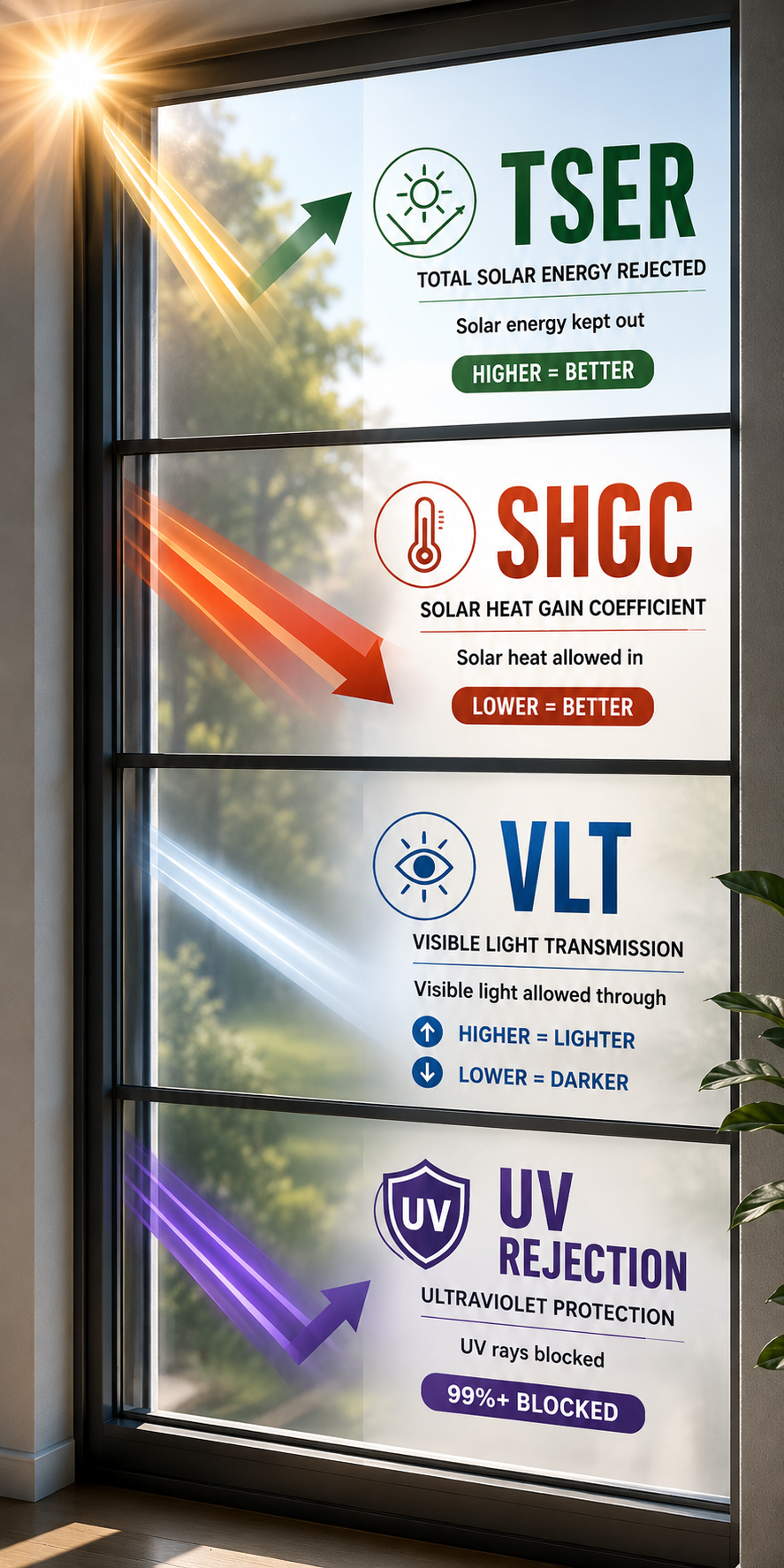
1. Total Solar Energy Rejected (TSER)
What does TSER mean?
TSER stands for Total Solar Energy Rejected.
It measures how much of the sun's total energy the window film prevents from entering your building.
That includes:
Ultraviolet (UV) radiation
Visible light
Infrared heat
Is a higher TSER better?
Yes. Generally speaking, a higher TSER means the film rejects more of the sun's total energy before it enters your home or building.
Why professionals pay attention to TSER
TSER is one of the best overall indicators of solar performance because it considers the entire solar spectrum, not just one part of it. If your goal is reducing heat, TSER is one of the first numbers we compare.
2. Solar Heat Gain Coefficient (SHGC)
What is SHGC?
SHGC measures how much solar heat actually enters the building after passing through the glass and window film.
Unlike TSER...Lower is better.
For example:
SHGC = 0.24 means about 24% of solar heat enters.
SHGC = 0.40 means about 40% enters.
Lower SHGC values generally mean cooler interior temperatures and improved energy efficiency.
3. Visible Light Transmission (VLT)
Visible Light Transmission measures how much natural daylight passes through the glass.
Examples:
70% = Very light appearance
50% = Light appearance
35% = Medium appearance
15% = Dark appearance
Is lower VLT better?
Not necessarily. A lower VLT creates a darker appearance and usually reduces more glare. A higher VLT preserves more natural daylight.
The right choice depends on your goals and appearance preferance.
4. UV Rejection
Professional architectural window films typically block 99% or more of harmful ultraviolet rays. While UV rejection has little impact on room temperature, it plays a major role in protecting:
Hardwood flooring
Furniture
Artwork
Merchandise
Fabrics
Cabinets
This helps reduce fading and extends the life of your interior finishes.
5. Glare Reduction
Glare reduction measures how much harsh visible sunlight is reduced. If you've ever had to close blinds because sunlight made your television impossible to watch or your computer difficult to read, you've experienced glare. Reducing glare can improve comfort without sacrificing your view.

Other Specifications You May See
Most specification sheets include additional measurements that help professionals compare products. These include:
Solar Reflectance
How much solar energy is reflected away from the glass.
Solar Absorption
How much solar energy is absorbed into the glass and film.
Visible Light Reflectance
How reflective the finished glass appears from inside and outside.
U-Factor
How well the window resists heat transfer. Lower values generally indicate better insulation.
Common Misconceptions
"The darkest film blocks the most heat."
Not anymore. Many modern ceramic and spectrally selective films reject significantly more heat than darker traditional films while maintaining a lighter, more natural appearance.
"The film with the highest infrared rejection is always the best."
This is one of the biggest misconceptions in the window film industry. Infrared energy (IR) represents only one portion of the sun's energy. A film with extremely high infrared rejection may not have the highest Total Solar Energy Rejected (TSER).
That's why professionals compare the complete specification sheet rather than one advertised percentage.
"Every film works on every window."
Unfortunately, that's not true. Different types of glass react differently to heat.
Installing an incompatible film can increase thermal stress and, in some cases, increase the risk of glass breakage. That's why one of the first things we verify before recommending a product is your existing glass type.
How We Compare Window Films at Shade9
When we review products, we don't simply choose whichever film has the biggest number.
Instead, we evaluate:
Glass compatibility
Total Solar Energy Rejected (TSER)
Solar Heat Gain Coefficient (SHGC)
Visible Light Transmission (VLT)
UV protection
Glare reduction
Exterior appearance
Warranty
Long-term durability
Your specific goals
A west-facing office with afternoon sun has different needs than a retail storefront or a living room with large picture windows. That's why two customers may receive different recommendations.
Frequently Asked Questions
What is the most important window film specification?
For overall solar performance, we usually start by comparing TSER and SHGC, then evaluate VLT, glare reduction, UV protection, and glass compatibility.
Is higher TSER always better?
Generally yes, but it should always be considered alongside appearance, SHGC, and compatibility with your existing glass.
Is lower SHGC better?
Yes. Lower SHGC means less solar heat enters the building.
Does darker window film reject more heat?
Not necessarily. Many lighter ceramic and spectrally selective films outperform much darker traditional films.
Why do different manufacturers use different numbers?
Manufacturers may emphasize different specifications or test methods, but the core performance ratings are largely the same across the industry.
The Bottom Line
A window film proposal shouldn't feel confusing. Once you understand the purpose of each performance rating, it becomes much easier to compare products and understand why one film may be recommended over another.
At Shade9 Window Tinting & Paint Protection, we believe our customers should understand exactly what they're investing in. We're always happy to explain every specification, compare products honestly, and recommend the film that's the best fit for your building, not simply the one with the biggest marketing claim.


Comments